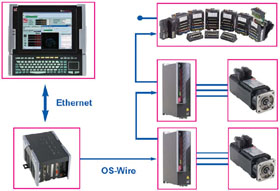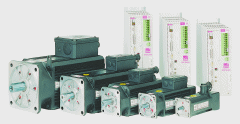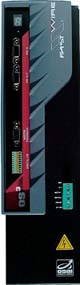
OS3 drives can be directly connected to the 3 phase supply network. They operate with a nominal 400V to 480V AC power input. This characteristic allows the product to be used in applications in a variety of geographical locations without need for a transformer to adapt to the local power source. The drives have an internal supply derived from the 3 phase to feed the control’s electronics. This feature allows dynamic breaking in the event of interruption of the power network. The control’s electronics are also supported by an external 24v d.c. supply. During the dynamic breaking phase, energy accumulated by the load is dissipated across internal breaking resistors. For extremely heavy work cycles an external breaking resistor can be connected in place of, or in parallel with the internal resistors. In common with most drives, the high-tension bus is accessible through a connector, this allows the use of external supplies containing breaking resistance. Various motors with different technologies can be controlled, such as permanent magnet motors, brush-less motors, induction motors and variable reluctance motors. Programmable inputs and outputs increase the drive’s flexibility. The OS3 family of drives is available in 2 different families : family A includes three power size 3/6A , 5/10A and 9/18A connected to the three-phase power supply with a voltage level between 220 VAC and 480 VAC +-10%. Family B includes three power size 5/10A , 10/20A and 15/30A connected to the three-phase power supply with a voltage level between 380VAC and 440VAC +-10%.
The OS3 motors are high voltage sinusoidal
(Sin-Cos) brushless motors, with low inertia and high
dynamic. They can also have an optional
holding brake and include a thermal sensor.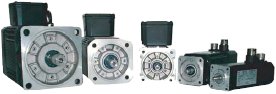
The standard transducer is a sinusoidal encoder (Sin-Cos) and all
motors have IP65 protection level.
The available standstill torques are from
0.6Nm up to 66Nm, with maximum speeds of 1200, 2000, 3000, 4000 and 6000 rpm.
NEW
The OS3CAN or Analog Servo Drive product line for brushless motors has been
specifically designed for applications in Industrial Automation such as:
Robots, textile machines, packaging machine, palletisers and all other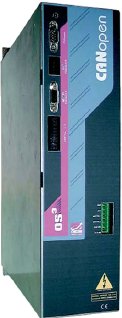
applications where the direct interface of the drive with the CANopen
fieldbus is required.
The drive integrates the CANopen interface, implemented according
to the DS402 profile, and can be driven in interpolation mode via real
time telegrams named PDO.
The drive requires a three phase power supply which can range
between 230V (-10%) to 480V (+10%) which eliminates the need for a
transformer.
Four models are available in terms of RMS current (3A, 5A, 9A and 18A)
and these come in two physical sizes. The sampling times are 100
microseconds for the current loop and 200 microseconds for velocity
and position loop.
It is also possible to connect an auxiliary encoder transducer to
increase the position control accuracy, especially when the coupling
between axis and motor is not rigid.
The drive speed reference command can also be via +/- 10V analogue signal
when used in combination with the SyncMotion with analogue interface. In this case, the drive transforms
the resolver signal into an encoder signal compatible
with the position input of the control; in this last case it is not
possible to connect an external position transducer to the
drive.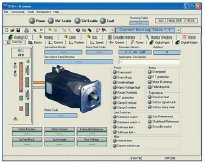
The drive parameters are setup using a configuration utility,
which runs under the Windows operating system.
This software utility also includes an interactive procedure
which allows the system to be tuned using the integrated
digital oscilloscope function, in order to achieve the best possible
performance.
The OS3CAN motors are high voltage sinusoidal
brushless motors, with low inertia and high
dynamic. They can also have an optional
holding brake and include a thermal sensor.
The position feedback is a resolver and all
motors have IP65 protection level.
The available standstill torques are from
0.6Nm up to 24Nm, with maximum speeds of 3000, 4000 and 6000 rpm.
The motors can support high acceleration and deceleration up to 110.000rad/sec².
|